I came across a small Kiosk installation for the first time at the Brooklyn Flea. They had cans of Jupina soda, Ricos meringues, bricks of espresso, La Cubanita guava paste, and orange gum balls exhibited together like a Cuban survivalist kit left under the Manhattan bridge. Asked to pick a handful of time capsule objects to explain Miami’s Little Havana circa 1985, I might choose the same ones (just adding a bottle of Royal Violets baby cologne for good measure). Read more
I was trying to solve my Cuban bread problem when I came across this article in The New York Times. Published in 1899, it’s a fascinating account by Dorothy Stanhope of turn-of-the-century Havana, a city finding it’s bearings after a long fought war of independence. Not surprisingly, she finds herself in a very different world:
In going to a strange country one does not as a rule think before-hand what he will eat while there. He assumes as a matter of course that he will live much as he does at home. To rid one’s mind of any idea of this kind, it is only necessary to visit Havana. Read more
I love guava in all its forms, but they can be a hard sell. When I was in college and brought back guava pastries from home, I could see my friends’ initial enthusiasm for an authentic Cuban indulgence give way to politeness with the first taste. Rich and sweet, they’re not for everyone. That’s why I was excited to see a recipe for guava sorbet included in Kate Zuckerman’s The Sweet Life: Desserts from Chanterelle, one of my favorite dessert cookbooks. I’d been looking for guavas all winter, but only found them a few weeks ago during a market tour in Chinatown. Less fragrant than red or strawberry guavas, I almost passed them by. Left to ripen for a few days, they made a refreshing sorbet, not at all too rich or sweet by any standard. Read more
You’ll have to excuse me for not writing about food. Yesterday, a ticket to see the American Ballet Theatre’s performance of La Sylphide at The Metropolitan Opera House fell from the sky unexpectedly, and I’m feeling a little ethereal today. There was a magical Sylph, a Scottish reel, and a poisoned gossamer veil, but it was still not as dramatic as the Edith Wharton story I cast myself in when I realized I’d be sitting in the romantic boxes ringing the theater. Watching principal Herman Cornejo dance the part of James, I thought of a Today segment I’d seen earlier that day about the recent emergence of Latin American artists and performers in film and television. This has long been true at ABT. In addition to the Argentinians Cornejo and Paloma Herrera, there is the Brazilian Marcelo Gomes, and Read more
For the past few days, I’ve been looking for references to food in Latin American literature. I haven’t found many yet to post, but I’ve thought of a million songs. El Manisero or The Peanut Vendor has always been one of my favorites. The vendor calls out to Caserita, a housewife, but she doesn’t realize it until the moment has just passed. I thought of being in the kitchen trying to teach myself something new, not recognizing the result I was seeking until it’s just a second too late. This performance by Antonio Machín captures the grace we’d all like to have but most need to leave for another day’s try.
I love camarones enchilados or creole-style shrimp. Growing up, it was the perfect every day dish thrown together at the last minute. On a good day, we had it with fluffy white race and maduros. On a rushed day, frozen shrimp and Cuban crackers. It was one of the first things I’d tried to make on my own, but there was always something missing. I looked at a few different versions pulling different elements from each. What really made the difference though was Alex Garcia’s recommendation from In a Cuban Kitchen to add the shrimp at the very end, allowing the flavors in the sauce to develop without over cooking the shrimp. Spicy but sweet and well worth the time.
This past week was my older sister Cami’s birthday, so I have been wound up planning an informal, low-key picnic in Central Park for 40 people. When I sent out the evite, I was worried that people wouldn’t be able to make it. When the RSVPs climbed, I was worried they all meant it when they said they were. I did my best to anticipate any logistical problems – were the bathrooms at the Delacorte Theater open, were leashed dogs allowed on the Great Lawn, were you allowed to hang a piñata from Central Park’s look-but-don’t-climb trees? (Answers: Yes, Yes, and Not if they see you). I prayed for sun but when I woke up to a gray Saturday morning, I was overwhelmed by the enormous number of things left to do for a picnic that was so obviously going be awash in early afternoon thunderstorms and soaked donkey piñatas.
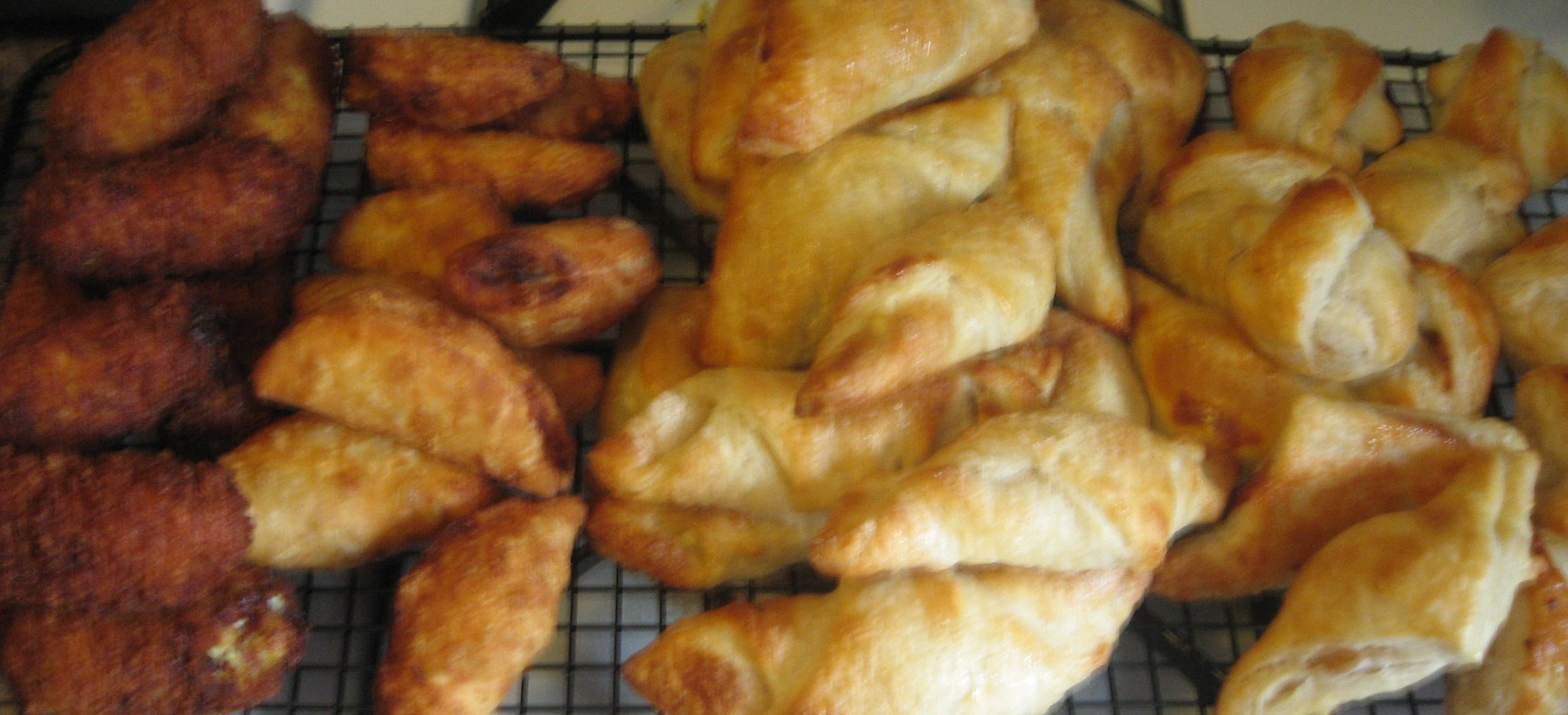
I wanted Cami to have the classic Cuban spread – cangrejitos (crab-shaped puffs filled with sweet ham), crispy croquetas, meat filled empanadas, bocaditos (small white bread sandwiches filled with flavored cream cheese), and pastelitos de guayaba. Armed with 4 sheets of puff pastry, 3 bricks of cream cheese, ham and picadillo fillings, and the last of the homemade guava paste I’d brought from home, I set to work. To add a further complication, I was also settling in my mother and Chiqui who had arrived the night before for a two week stay (Chiqui being the 8 pound chihuahua who has replaced me in my mother’s affections).
The few hours I had given myself to prepare evaporated between finding extra closet space, outlets for chargers and rolling out emapanada dough. With just an hour to go, it seemed hopeless, and I started weighing the evils of less food versus having friends wandering the park looking for a spot that hadn’t been staked out. Then someone, probably Chiqui, set my iTunes to Celia Cruz. Now while listening to Celia cannot solve every problem, it does make unhappiness almost impossible. Somewhere Between Cao Cao Mani Picao and Oye Mi Rumba, time slowed enough for me to finish my first empanadas and my mother to cut the crusts of my sister’s favorite tuna bocaditos. By the time I climbed up the subway stairs to 81st Street & Central Park West with a box full of Cuban treats and five minutes to spare, I could finally see the blue skies I first felt when Celia started singing.
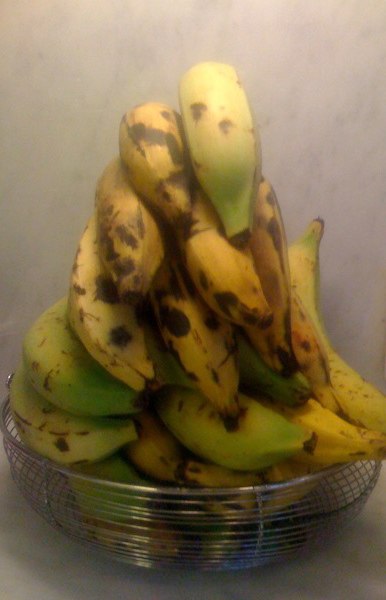
I should confess that when I admitted to my host family, during my year abroad in Madrid, that one of my favorite dishes from home was tortilla de plátanos maduros (fried ripe plantain omelette), I thought they might ask me to leave…the country. I don’t think they would have been so shocked if they knew that for Cubans, plantains are as ubiquitous as the potatoes they put in their own tortilla de patatas. Read more
I love doing unnecessary things, and I’m good at them. I run ridiculous distances when not being chased, am a meticulous Christmas present wrapper, and a refrigerator door alphabetizer. That’s why I am determined to make guava pastries from scratch even though I haven’t been able to pull off the puff pastry. I tried again this afternoon with a dough I had made, and I ended up with guava scone/pop tarts instead. To add insult to injury, I made a second batch with frozen Trader Joe’s artisan pastry that puffed pretty and were much less trouble. Still, no sense of ownership on the Trader Joe’s, so I’ll just have to keep trying.
When I asked my grandmother who’d taught her how to cook, her answer was always “el exilio”. Married in the 40’s and raising children in early 50’s Havana, she was very much a part of a generation that believed every modern convenience was invented to limit their time in the kitchen – a movement that if she hadn’t followed, she would have invented. Then like many women emigrating to Miami and starting over in a new country with less help and fewer resources to feed their families, the one guide they all shared was Nitza Villapol’s Cocina Criolla.
Known as the Cuban Julia Child (if those two things aren’t in fact mutually exclusive), her book became the center of every cuban kitchen in exile, providing a way for them to see their family’s through a difficult transition and begin recreating what they’d left behind. A controversial figure, whenever I have a basic question about Cuban cooking the first suggestion is always to check el libro de Nitza. Reading through it now, I find all kinds of idiosyncrasies. Cubans are unrepentant Francophiles so while they’re french terms sprinkled throughout, there’s an entire section that puts “pie” in quotes and names ingredients by their American brand names. Only available in a slight, paperback edition that looks dog-eared even when it’s new, it’s a popular gift even now for Cuban women who are either getting married or leaving home, whichever comes first. My own copy found me when I was helping to pack my grandmother’s belongings after she’d passed. I was shocked. First, that she owned a cookbook and second that it had clearly been used. Read more


 boxes ringing the theater. Watching principal






 hungry sofia